Employee retention key takeaways:
- Employee engagement declines 12.3% between onboarding and years 3–5, right when most employees decide whether to stay.
- Employees are 94% more likely to stay when they believe their company invests in their growth and development.
- 78% of HR leaders say managers aren’t highly effective at supporting employee development.
- Mid-tenure employees experience the sharpest declines in execution, leadership confidence, and long-term commitment.
- Organizations that measure engagement by tenure can identify retention risk years before regrettable turnover appears.
The employee retention problem most companies miss
You didn’t see it coming.
Your high-potential employee gives notice. A top performer leaves for a competitor. Yet another person on the business development team resigns. And then another.
Suddenly, the team feels unstable. Hiring starts again. Managers are stretched thin. Momentum slows.
And the frustrating part? These weren’t struggling employees. They were some of your strongest.
Most organizations treat employee retention like an onboarding problem. Get people in. Get them engaged early. Build culture. Create a good first experience. But the biggest retention risk usually shows up later.
Right around the time employees should be hitting their stride.
The hidden curve behind employee engagement and retention
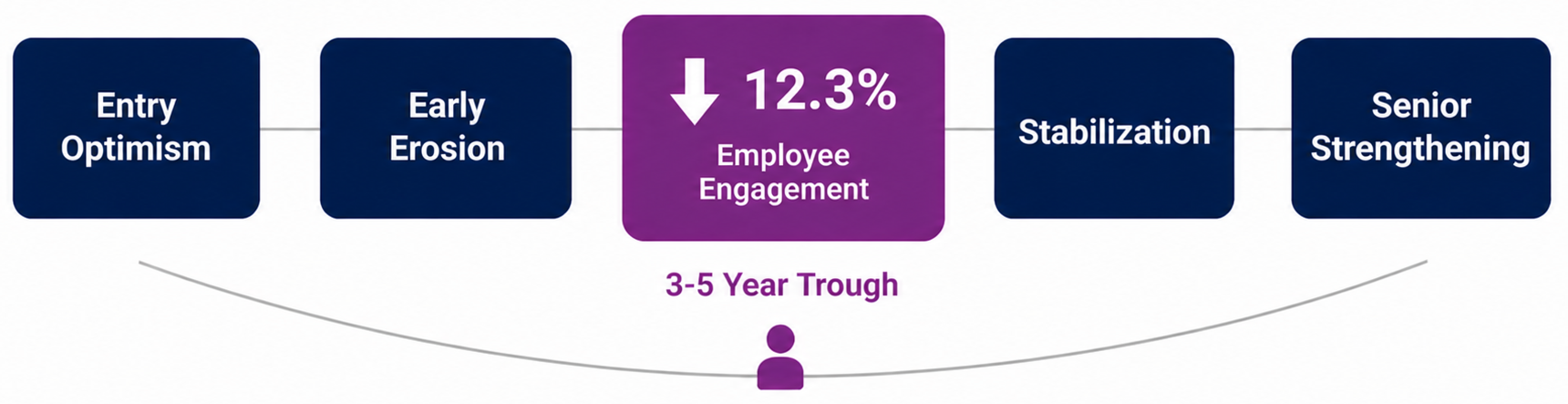
The Energage Tenure Lifecycle Cuve Model
Your employee engagement problem starts long before the resignation letter.
That’s what Energage research uncovered in what we call the Tenure Lifecycle Curve — a predictable pattern across more than 30 million employee survey responses showing that workplace experience steadily declines after onboarding, bottoms out between years 3–5, and only gradually recovers afterward.
And that timing matters.
Because 3–5 years is also when employees are deciding whether they still see a future with your organization.
Employee engagement declines when employees should be thriving
The data follows a remarkably consistent pattern.
Employees join organizations optimistic and engaged. Early onboarding creates momentum. Managers are attentive. Learning curves are steep. New opportunities feel exciting.
Then the experience changes.
Responsibilities expand. Expectations rise. Cross-functional complexity increases. Employees gain visibility into how decisions actually get made.
And engagement starts to fall.
Energage research found that between entry and the 3–5 year mark:
- Employee engagement declines 12.3%.
- Empowered to Execute declines 11.6%.
- Overall workplace experience declines 9%.
This isn’t a temporary dip. It’s a predictable pattern.
The lowest point in employee experience consistently happens during the exact period when employees are expected to contribute at the highest levels.
That’s the disconnect.
Mid-tenure employees aren’t disengaging because they care less. They’re disengaging because they see more.
Why employees start struggling after they're fully ramped
Organizations often assume disengagement is about motivation. Our research suggests something different: As employees grow more capable, the systems around them often fail to keep pace.
We call this the Capability-System Gap — the growing disconnect between increasing employee capability and the operational systems meant to support execution.
Employees aren’t learning the job anymore. They’re navigating the organization itself.
That’s where friction starts to build:
- Unclear decision-making.
- Competing priorities.
- Coordination breakdowns.
- Lack of visibility.
- Limited authority despite growing accountability.
And employees feel it long before turnover appears in HR dashboards.
The 3-5 year window is when employees rethink things
This is the part many organizations miss.
Turnover usually doesn’t happen impulsively. Employees evaluate, reevaluate, and test assumptions. They quietly compare what was promised with what they experience day to day.
The 3–5 year window becomes a judgment point.
Employees move from asking: “What could this become?” to: “Is this sustainable here?”
That shift is clear in the data. Three of the sharpest declines during mid-tenure center around:
- Execution
- Clued-In Leaders
- Commitment
In other words, employees begin questioning:
- If work can actually get done effectively.
- Whether leadership understands operational reality.
- If they still feel committed to staying long-term.
This is also why regrettable turnover is so expensive.
These employees are fully ramped. They carry institutional knowledge. They understand your customers, systems, and internal dynamics. They’re often the people managers rely on most heavily.
Then they leave.
And here’s where the story becomes even more important: the research suggests employees aren’t looking for a different employer.
They’re looking for a better growth experience.
Organizations promise development — but the reality is different
Employees don’t leave because companies talk about development. They leave because the experience doesn’t live up to the promise.
Nearly every organization says employee development is a strategic priority:
- “We invest in growth.”
- “We care about careers.”
- “Development matters here.”
And to be fair, many organizations mean it. But employees experience development through managers. And that’s where things begin to break down.
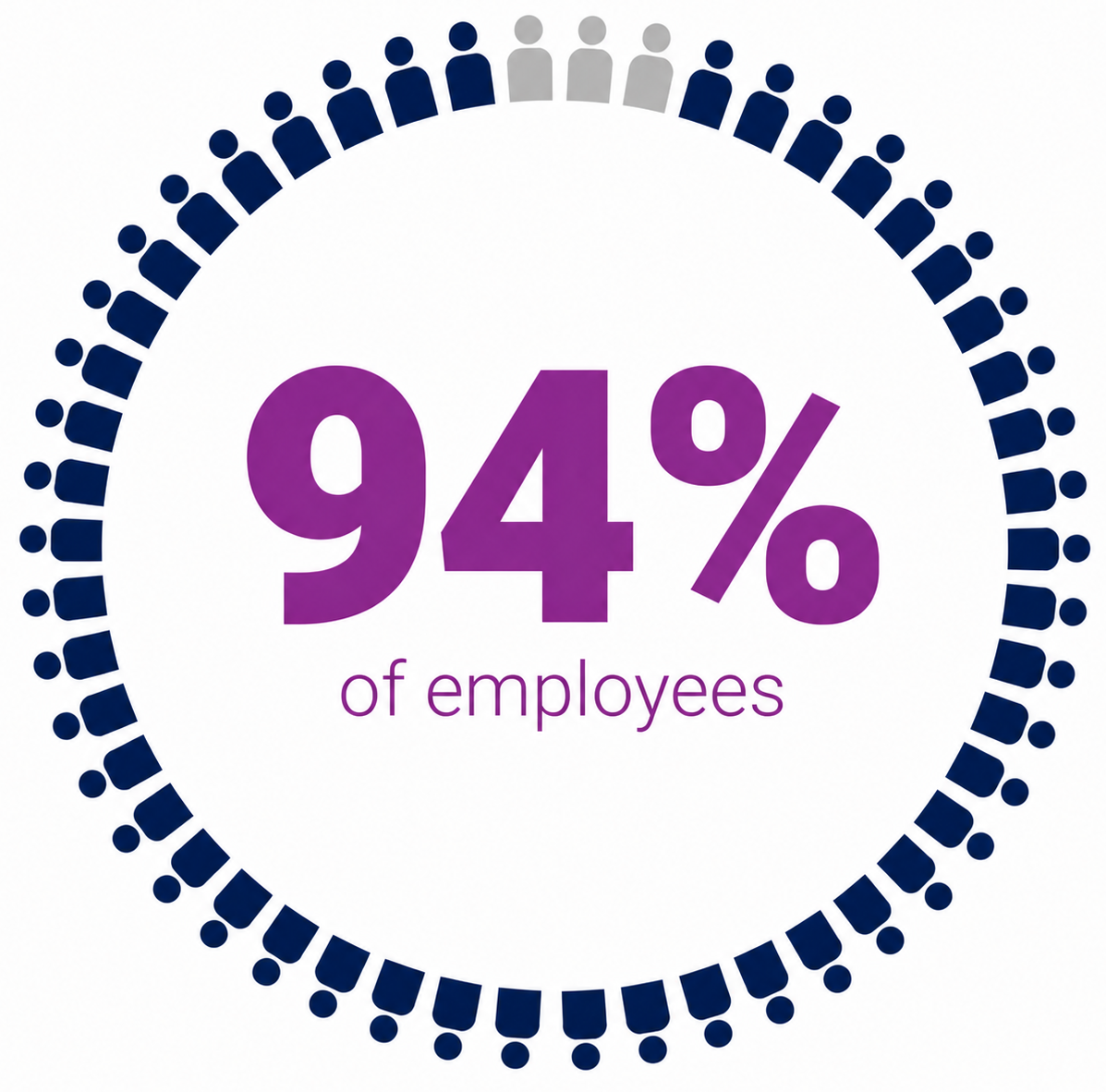
LinkedIn reports that 94% of employees would stay longer at a company if it invested in their learning and development.
Most employers state that development is a strategic priority. The problem is, the managers who are expected to support it aren’t properly equipped.
Managers aren't equipped for employee development
Energage research found that the issue isn’t intent. It’s execution:
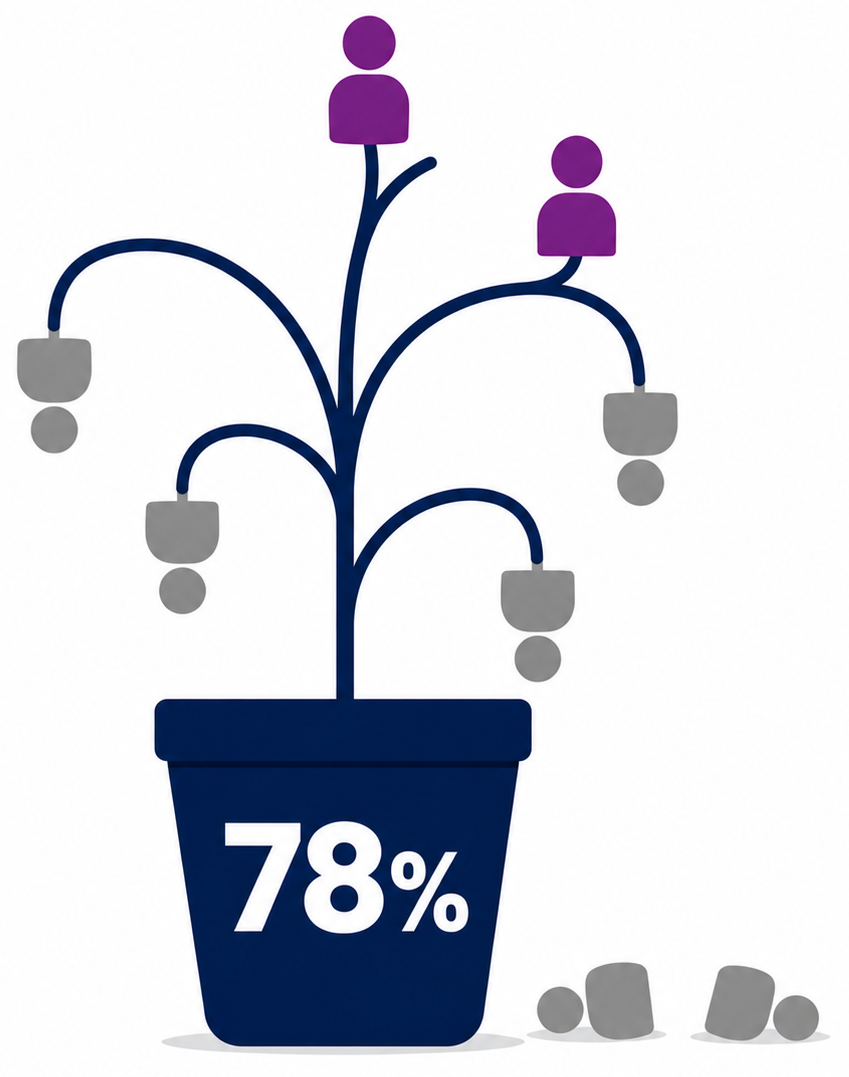
- 78% of HR leaders say managers are not highly effective at supporting employee development.
- More than one-third of employees say they are not receiving critical development support from managers.
Most managers are still heavily focused on performance management — things like giving feedback, reviews, accountability, and output.
But employees want — and need — something different:
- Coaching
- Career direction
- Growth conversations
- Stretch opportunities
- Help navigating what comes next
That gap matters.
Because employees don’t experience development through company messaging. They experience it through everyday interactions with managers.
And when those experiences feel inconsistent, employee engagement starts to erode.
Five things organizations need to do to reduce regrettable turnover
The good news is this problem is measurable. Which means it’s manageable.
Organizations that reduce regrettable turnover tend to approach retention differently. They stop treating it as an onboarding issue and start treating it as an employee lifecycle strategy.
Here’s where to focus.
1. Measure employee engagement by tenure
Most organizations flatten the problem in averages.
Overall engagement scores can look stable while specific tenure groups are struggling underneath the surface.
The 1–3-year and 3–5-year windows deserve dedicated attention.
This is where patterns become visible. You can’t solve a problem you average away. Instead, measure by tenure:
- Employee engagement
- Execution enablement
- Manager effectiveness
- Career growth perceptions
2. Equip managers to coach, not just manage performance
Managers are shouldering too much of the employee development burden with insufficient support. Retention improves when employees can see momentum in their future.
That’s why it’s important to build practical coaching capability into management expectations:
- Career conversations
- Development planning
- Growth mapping
- Stretch opportunity discussions
- Forward-looking check-ins
3. Systematize growth and development
Development cannot depend entirely on individual manager consistency. It needs structure. The organizations making the strongest progress integrate development into how work actually happens. It’s not more programs. It’s a more connected growth experience.:
- Individual Development Plans (IDPs)
- Career pathing
- Internal mobility
- Mentoring
- Cross-functional projects
- Ongoing growth conversations
- Integrated talent systems
Research shows that the nation’s award-winning Top Workplaces embed development into operational rhythms instead of treating it as a disconnected HR initiative.
4. Reduce execution friction
One of the clearest insights in the research is that engagement and execution decline together.
That matters. Employees lose energy when work becomes unnecessarily difficult, and retention problems often grow from operational friction:
- Unclear ownership
- Slow decisions
- Poor coordination
- Competing priorities
- Process overload
- Lack of authority
In other words, employees can tolerate hard work, but they struggle with avoidable friction.
This is especially important during mid-tenure, when employees are expected to operate with greater autonomy and broader responsibility.
5. Pull senior-tenure advantage forward earlier
One of the most interesting findings in the Tenure Lifecycle Curve research is that employee engagement improves again among long-tenured employees.
Why? Because senior employees often experience:
- Greater clarity
- More influence
- Stronger relationships
- Increased autonomy
- Deeper organizational understanding
The strategic question becomes: Why wait 10+ years to create those conditions?
You can reduce the depth of the mid-tenure trough by introducing things like decision authority, visibility, autonomy, career clarity, and access to leadership earlier in the employee lifecycle.
The goal isn’t simply retaining employees long enough to recover from the dip. It’s preventing the dip from becoming so deep in the first place.
The employee retention opportunity most miss
Most organizations focus heavily on attracting talent. Fewer spend enough time designing what happens after employees become fully capable.
That’s where retention risk quietly grows.
The companies that improve employee retention over the next decade won’t just build better onboarding experiences. They’ll build better mid-career experiences. Because employees rarely leave the moment something feels wrong.
They leave after years of evaluating whether the organization is still growing with them.
Request a Free Tenure Gap Assessment
Discover where retention risk may already be forming inside your organization.
Schedule a free Tenure Gap Assessment with our talent management experts.
What you’ll get:
- Where engagement declines by tenure and role.
- Your highest-risk retention moments across the company.
- A clear plan to strengthen managers and keep employees.
FAQs about employee tenure, retention, and engagement
Employees often leave after 3–5 years because employee engagement and workplace experience decline during mid-tenure. As responsibilities grow, many employees experience increased operational friction, limited career visibility, and inconsistent development support. This is also the period when employees begin reassessing their long-term future with an organization.
The Tenure Lifecycle Curve is an employee experience pattern identified by Energage research across more than 30 million employee survey responses. It shows that employee engagement and workplace experience tend to decline after onboarding, reach their lowest point between years 3–5, and gradually recover among longer-tenured employees.
Employee engagement often declines when employee responsibilities increase faster than organizational support systems. Common causes include unclear decision-making, lack of growth opportunities, poor manager support, competing priorities, and operational friction that makes work harder to execute effectively.
Employee development has a direct impact on retention. LinkedIn research found that 94% of employees would stay longer at a company if it invested in their learning and development. Employees are more likely to remain engaged and committed when they experience consistent coaching, career growth conversations, and opportunities to develop new skills.
Employee development has a direct impact on retention. LinkedIn research found that 94% of employees would stay longer at a company if it invested in their learning and development. Employees are more likely to remain engaged and committed when they experience consistent coaching, career growth conversations, and opportunities to develop new skills.