Employee engagement and retention risk key takeaways
- Employee engagement declines most sharply between years 3–5, not during onboarding or early tenure.
- Mid-tenure employees face a growing gap between increasing responsibility and outdated organizational systems.
- The biggest declines are tied to execution friction, decision clarity, and leadership alignment — not culture alone.
- High performers remain productive while disengagement builds, masking retention risk until it’s advanced.
- Organizations overinvest in early-tenure retention while overlooking the employee lifecycle stage where long-term commitment is truly evaluated.
The onboarding obsession: are you looking the wrong way?
We’ve all been there. A new hire starts, and the red carpet rolls out. There are welcome lunches, structured 90-day plans, and check-ins to ensure they’re “settling in.” We obsess over that first year because we’ve been told it’s the ultimate “make or break” period for retention. But Energage research tells a much more complicated story.
While the first year is important, the most significant drop in employee experience doesn’t happen on day 90 or even day 365. It happens years later, when your employees should be delivering their highest value.
The myth: the engagement danger zone ends after year one
It’s a common leadership assumption: if someone makes it past their first anniversary, they’re “safe.” We assume they’ve integrated into the culture, mastered their role, and are now on a steady upward trajectory.
The reality? Early decline is a real phenomenon, but it’s often just the beginning of a much steeper drop. If you’re only focusing on the “honeymoon phase” of onboarding, you’re missing the massive structural risk waiting just over the horizon.
The reality: Navigating the mid-tenure "trough"
The Energage People Science Team recently analyzed millions of survey responses to map out the Tenure Lifecycle Curve. What they found was a consistent, sobering pattern.
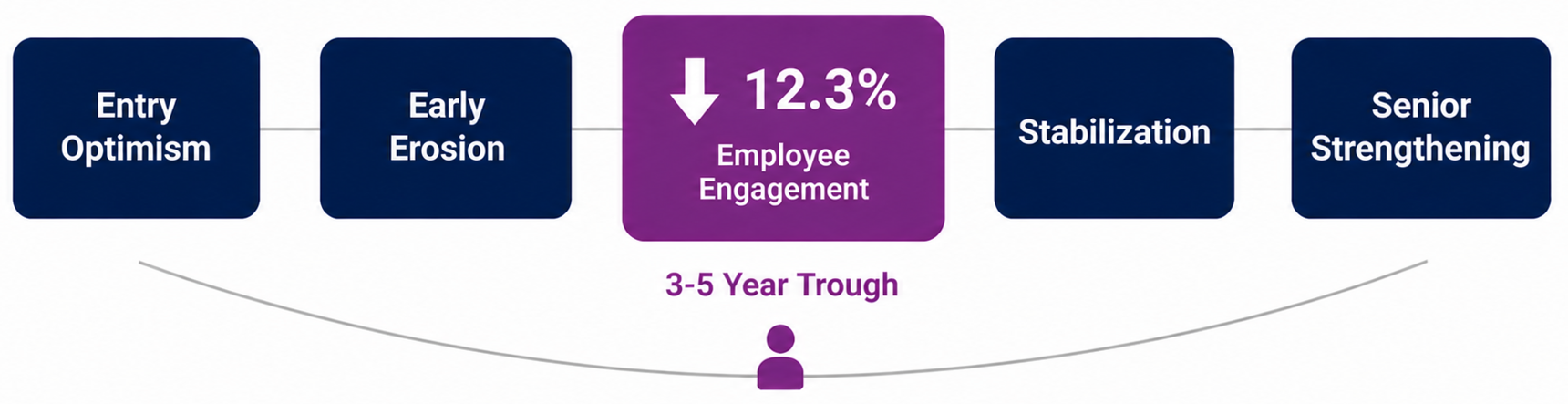
Research on what drives employee engagement over time shows that it doesn’t stay flat or rise as people gain experience. Instead, it follows a “trough” shape. After the initial excitement of a new role wears off, engagement begins to dip, reaching its absolute lowest point between years three and five. This isn’t a small-sample-size anomaly; it’s a verified trend across industries showing that our most “stable” employees are often our most disengaged.
The Energage Tenure Lifecycle Curve Model
Employee engagement doesn’t rise with experience — it drops to its lowest point between years 3–5, when employees should be at their strongest and most committed.
What's really driving employee engagement decline?
Hint: It’s not your culture.
When engagement slips, leaders usually look for causes: a bad manager, a lack of “fun” culture events, or general burnout. But our research points to another culprit: Friction.
- The Employee Scales Up: Between years three and five, an employee’s scope of responsibility, expertise, and expectations grow exponentially.
- The System Stagnates: Meanwhile, the organizational systems around them, such as the decision-making processes, coordination tools, and clarity of authority, lag behind.
What you’re left with is your best people are now capable of doing more, but they’re constantly hitting “low-gear” systems that haven’t evolved to support their new speed.
The 3-5 year stress test: watching the engagement spark fade
By years three to five, employees have moved beyond onboarding and early optimism. They’ve taken on greater responsibility, built credibility, and become highly productive contributors. But this is also the point at which many quietly begin reevaluating the organization itself.
- They now see where decisions stall.
- Where collaboration breaks down.
- Where priorities conflict.
- And where growth opportunities feel unclear or limited.
This is what makes mid-tenure disengagement so dangerous. High performers usually continue delivering results long after their connection to the organization begins to erode.
Research on what drives employee engagement over time shows that employees stay engaged when organizations continue to scale support, clarity, and growth opportunities alongside increased responsibility. When that support stalls, disengagement builds quietly — long before turnover becomes visible.
The hidden engagement danger: losing your future leaders
The 3-5-year cohort is one of the biggest hidden employee retention risks organizations face. The reason is that these individuals are fully ramped, highly productive, and sitting directly in your leadership pipeline.
By the time their disengagement becomes visible through a drop in productivity or a sudden resignation letter, they’ve already checked out.
The damage is done long before the exit interview.
Your biggest retention risk isn’t new hires — it’s the high-performing employees who already understand the system well enough to see what’s broken but aren’t empowered enough to fix it.
Where organizations misfire
Most companies over-invest in:
- Flashy onboarding
- Surface-level culture initiatives
- General manager training
Instead of investing in what matters. Operating systems, execution enablement, and radical decision clarity.
Three ways to keep employees engaged
If you want to avoid the 3-5 trough and keep your best people engaged, you need to change your mid-tenure strategy:
1. Design beyond day one:
Stop treating engagement as an “onboarding goal.” Your employee experience strategy should have specific milestones for the 1,000-day mark, not just the 90-day mark.
2. Treat years 3-5 as a critical intervention window:
This shouldn’t be a “maintenance” period. This is your highest-risk zone. Use this time to re-recruit your best people by addressing the specific frictions they face.
The ultimate guide to employee check-ins for better connection
3. Pull forward senior-tenure advantages:
Don’t make people wait 10 years for “senior” perks. Introduce autonomy, high-level clarity, and real influence earlier in the lifecycle to give them the “fix-it” power they crave.
Closing insight: think systems, not sentiments
At the end of the day, employee engagement doesn’t decline because people suddenly change their minds about your company. It declines because systems don’t scale as fast as people do.
Energage uses large-scale data to reveal these hidden structural risks that leaders often can’t see from the top down. By identifying these “cliff” zones early, you can stop fixing the symptoms and start fixing the systems.
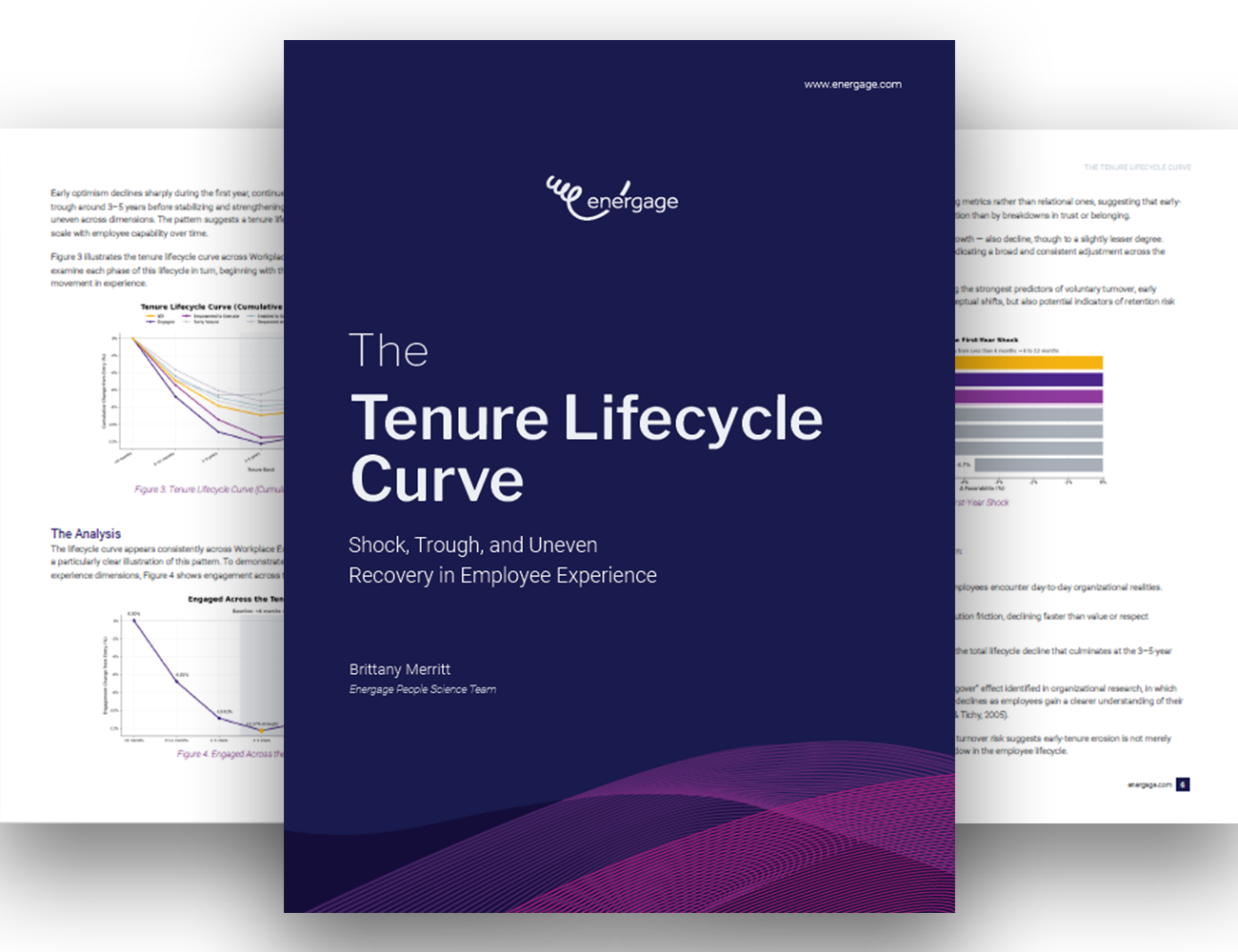
See the employee engagement and tenure gap research for yourself
Download the full Tenure Lifecycle Curve report to see exactly how to keep your top talent engaged for the long haul.
FAQs about employee engagement decline and mid-tenure retention
Employee engagement often declines during the 3–5 year tenure window because employee responsibilities grow faster than organizational systems evolve. As employees gain experience, they become more aware of operational friction, unclear decision-making, limited growth opportunities, and leadership gaps — all of which contribute to disengagement.
The employee engagement “cliff” describes the point in the employee lifecycle where engagement and workplace experience decline most sharply. Research shows this mid-tenure period is a critical retention risk because employees are fully ramped, highly productive, and actively evaluating their long-term future with the organization.
Mid-tenure disengagement is typically driven by stalled growth, limited career visibility, execution friction, and a lack of development support. Employees at this stage often understand organizational weaknesses clearly but lack the authority or support to improve them.
Mid-tenure employees are often among an organization’s most valuable contributors. They hold institutional knowledge, operate at high productivity levels, and represent future leadership pipelines. Losing them creates higher replacement costs, operational disruption, and leadership succession risk.
Organizations can reduce long-term disengagement by strengthening manager-led development, improving career path visibility, scaling decision clarity, and aligning systems with employee growth. Continuous development conversations and clearer advancement opportunities are especially important during years 3–5.
Strong onboarding helps employees succeed early, but it does not eliminate long-term retention risk. Research suggests employee experience often declines later in the lifecycle, particularly after employees take on greater responsibility and begin evaluating whether the organization can support their continued growth.
Common signs include reduced enthusiasm for growth opportunities, lower confidence in leadership, frustration with execution barriers, limited participation in development conversations, and quiet withdrawal from long-term career planning within the organization.
Employee lifecycle engagement refers to how employee experience changes over time, from onboarding through long-term tenure. Research shows engagement is not static — it evolves across different career stages and often declines during mid-tenure if organizations fail to scale support, clarity, and development opportunities.